


.png)












How to Effectively Communicate with Frontline Employees
Feeling lost about how to reach and connect with your frontline? Here are ten tried and true methods to get you started.
.png)
The Realization
You just discovered something most at your organization don't want to admit: your frontline workers might not be getting your messages.
That company-wide update you sent last week? Half your team never saw it. The benefits enrollment deadline? Buried in an email that frontline workers without company accounts couldn't access. The emergency weather alert? Still sitting unread in an app that two-thirds of your workforce never downloaded.
If you just completed our frontline communication assessment, you now have a score that quantifies what you probably already suspected: your deskless workers are hard to reach. Critical information isn't landing.
The good news? You're not alone. The better news? There are proven approaches that work.
Let's break down the 11 critical areas where frontline communication succeeds or fails. For each one, you'll see why certain approaches earn higher scores and how leading organizations are solving these challenges at scale.
Choose the Right Communication Channel
You can craft the perfect communication, but if it's delivered through a channel your frontline doesn't use, you've wasted your time. Channel selection isn't about preference. It's about reach and effectiveness.
Here's why SMS-based frontline communication scores highest: your workers already have their phones. They already check texts constantly. There's no app to download, no password to remember, no new behavior to adopt. The barrier to entry is zero.
Dedicated apps offer more bells and whistles, but they face a fundamental problem: adoption. Even when companies mandate app downloads, most workers simply don't do it. Airship reports that on average less than 60% of those who even download the app enable push notifications, and even worse: less than 9% of push notifications are interacted with.
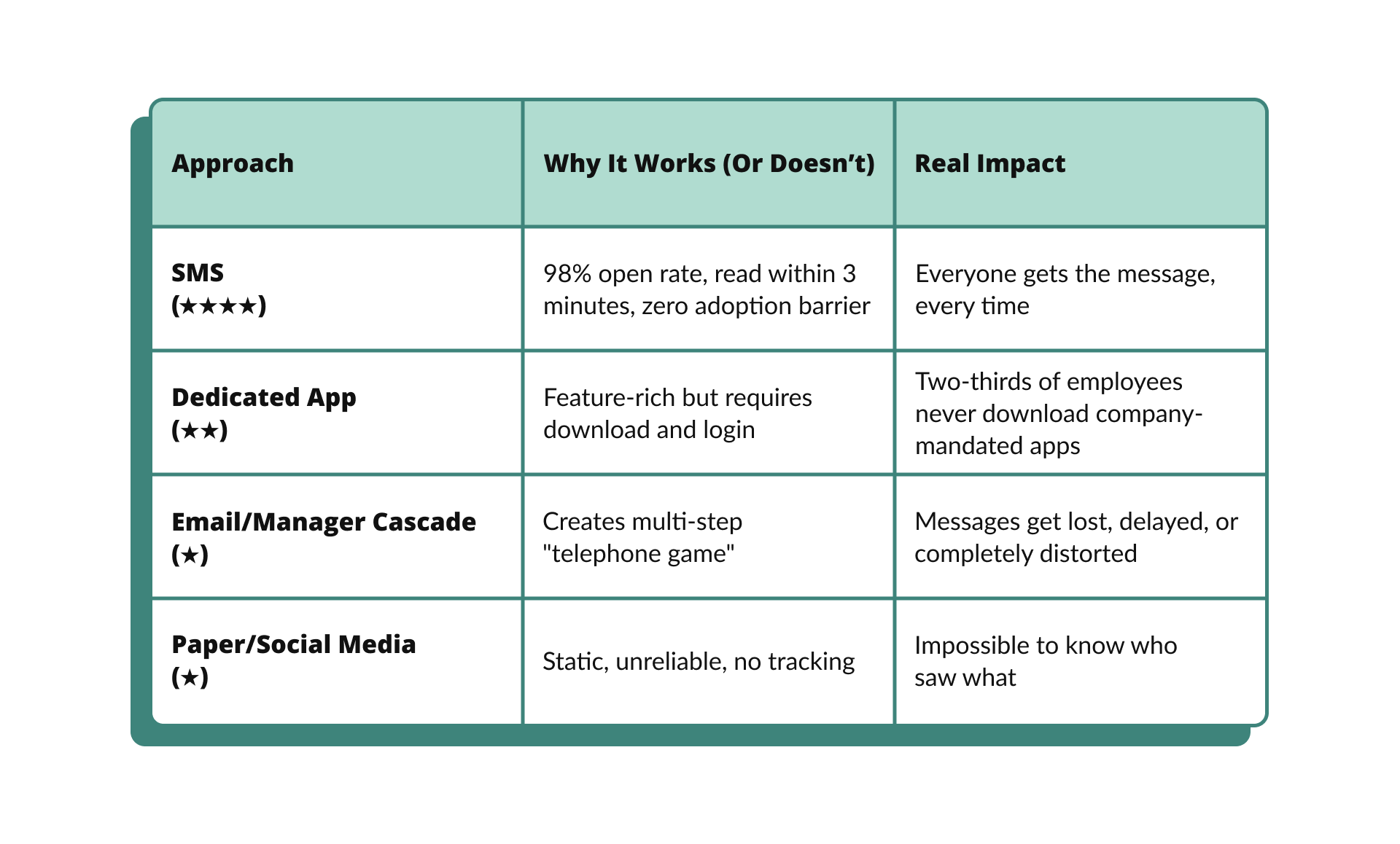
Email cascades through managers sound reasonable until you watch them in action. Corporate sends a message to regional managers, who forward it to district managers, who tell store managers, who are supposed to share it with shift leads... who might mention it to their teams. By the time the message reaches the frontline, it's been summarized, paraphrased, and stripped of critical details.
Paper-based communication and social media score lowest because they're fundamentally unreliable. Break room posters go unread. Paper schedules get lost. Social media groups get buried in feeds. And you have absolutely no way to confirm who saw your message and who didn't.
Understand Your Location Complexity
Managing communication across multiple locations isn't just harder. It's harder in ways that aren't immediately obvious until something goes wrong.
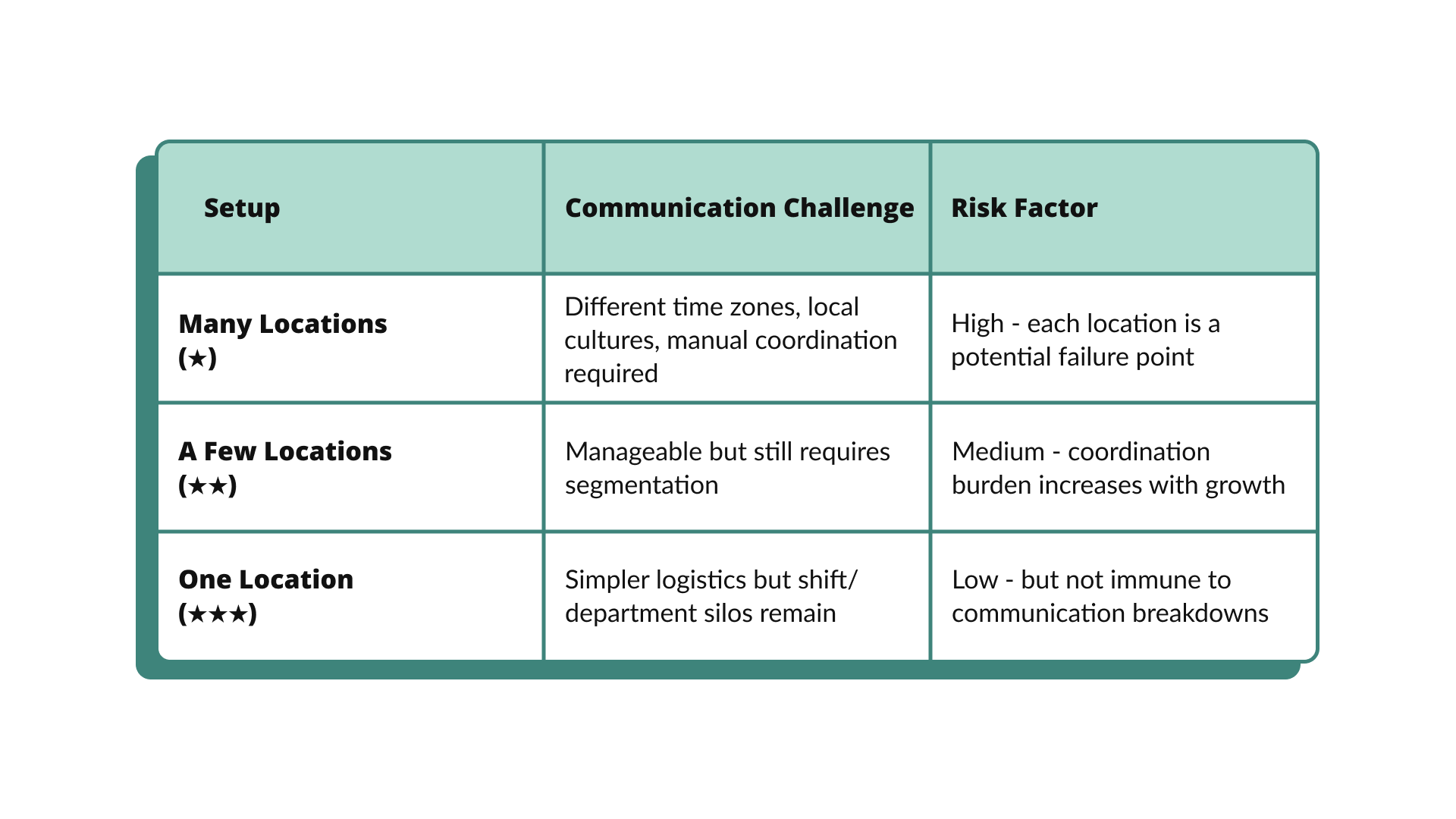
Organizations with workers spread across many locations face unique obstacles. A message sent at 9 AM corporate time hits your East Coast locations during their lunch rush and your West Coast locations before they've opened. Local managers interpret corporate messages through their own filters. Regional differences in culture, language, and work practices mean one-size-fits-all communication often fits nobody.
Even single-location organizations aren't off the hook. Different shifts create different cultures. Day shift workers never see night shift workers. Departments develop their own communication norms. Without intentional systems, information silos develop even under one roof.
Measure and Maximize Adoption
This is where theory meets brutal reality. You might have the best communication strategy in the world, but if half your workforce isn't enrolled in your system, you're not communicating with your frontline. You're communicating with a fraction of them while the rest remain completely in the dark.
Organizations achieving 95% or more reach have eliminated the barriers to entry. There are no apps to download, no accounts to create, no training required. Workers are automatically enrolled based on their presence in the payroll system. Communication just works.
Those in the 50-94% range have partial success, which sounds acceptable until you realize it means anywhere from 3% to 49% of your workforce never sees your messages. That's not a rounding error. That's hundreds or thousands of workers operating without critical information.
Under 50%? You've essentially created two workforces: the informed and the uninformed. Guess which group has higher turnover, lower engagement, and more safety incidents?

And if you don't know your adoption rate? That's perhaps the biggest red flag of all. It signals you lack visibility into one of your most important operational metrics.
Prepare for Emergency Communication
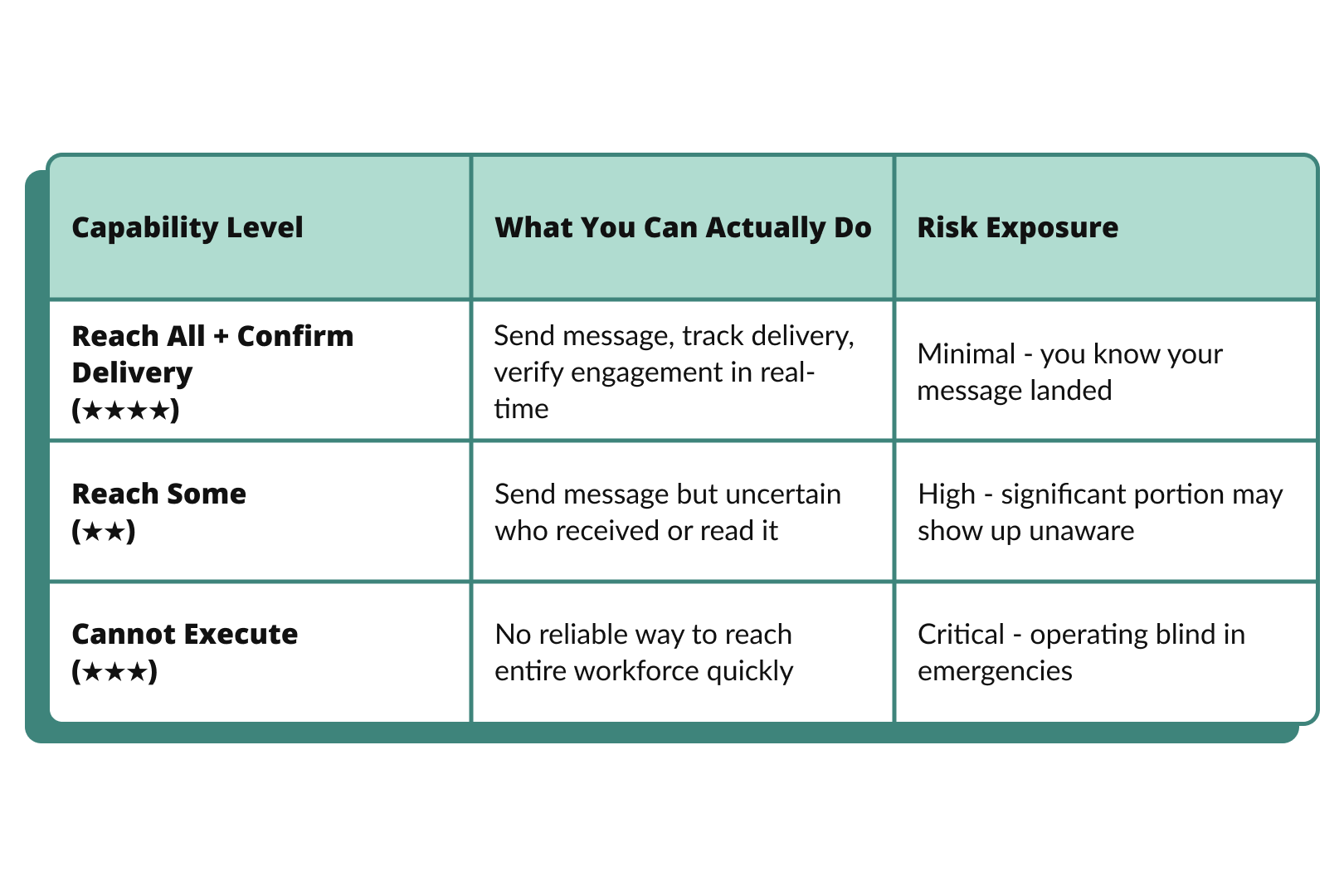
Organizations that score highest can execute emergency communication with confidence. They have direct channels to every worker. They can see delivery confirmation in real-time. They know within minutes who has and hasn't read the message, allowing for follow-up with specific individuals.
Those who can only reach "some" of their frontline face serious operational and safety risks. When you send an emergency message but don't know if it was received, you're left guessing. Do you call each store individually? Do you assume people got it? Do you just hope for the best?
Organizations that simply can't execute fast, wide-reaching communication in emergencies aren't just operationally disadvantaged. They're exposing themselves to safety risks, potential liability, and the erosion of trust that comes when employees feel uninformed during critical moments.

Bridge the Email Access Gap
The reality is, creating emails for every frontline employee is not sustainable. If your frontline workforce doesn't have email, but you're leaning on it as your primary form of communication? You have a communication gap.
When benefits enrollment reminders, policy updates, company newsletters, and recognition announcements all flow through email, you've automatically excluded workers without email addresses from the conversation. They're not just missing non-essential updates. They're missing information that directly affects their pay, benefits, and career opportunities.
Organizations where only managers have email access create an unintentional two-tiered communication system. Managers stay informed. Frontline workers depend entirely on whether their manager remembers to share information, has time to share it, or thinks it's important enough to share.
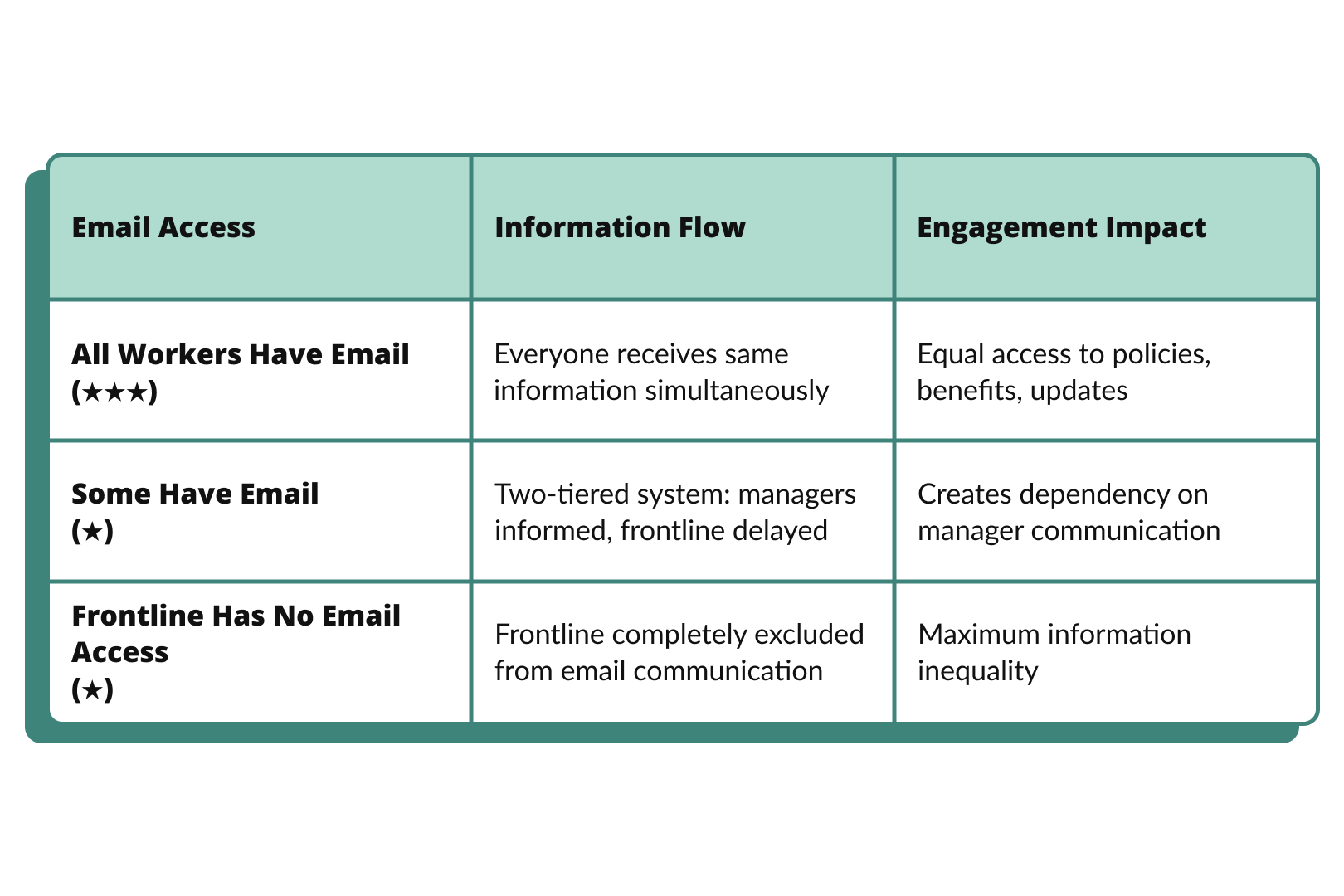
Frontline workers consistently report feeling less informed, less valued, and less connected to their organizations than their office-based counterparts. This isn't surprising. They literally receive less information.
Make Information Accessible on Mobile
Benefits details, policy handbooks, shift schedules, training materials, safety procedures. These aren't nice-to-have resources. They're essential information that directly impacts your workers' lives, your compliance posture, and your operational effectiveness.
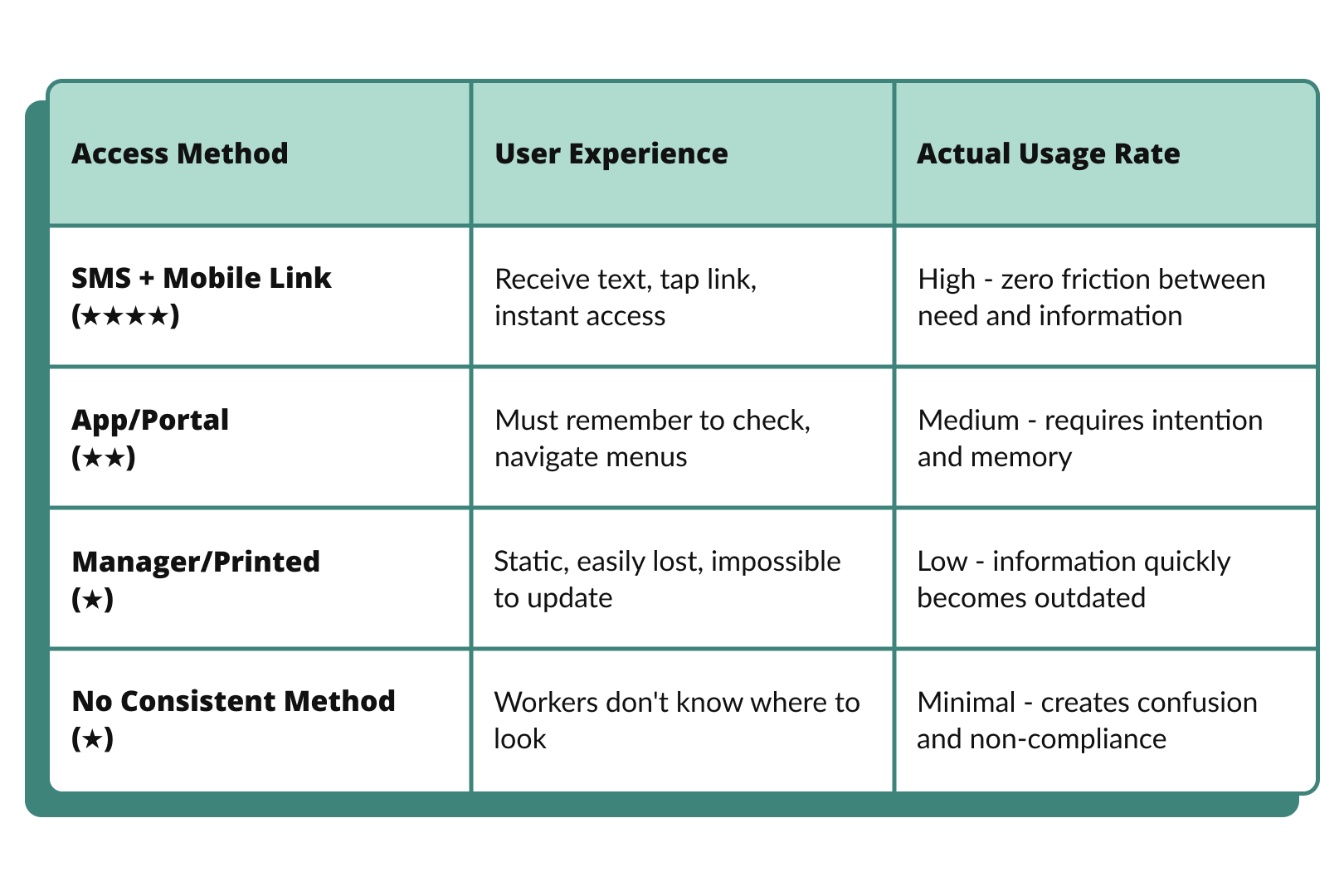
SMS-based information access scores highest because it eliminates every possible friction point. Workers receive a text message with a link. They tap it. They see the information immediately. No apps to open, no portals to navigate, no wondering where to find what they need.
App-based portals and intranets offer more robust functionality, but they require workers to remember to check them. That works for office workers at computers all day. It works less well for frontline workers who are serving customers, stocking shelves, or managing production lines.
Automate Recognition and Engagement
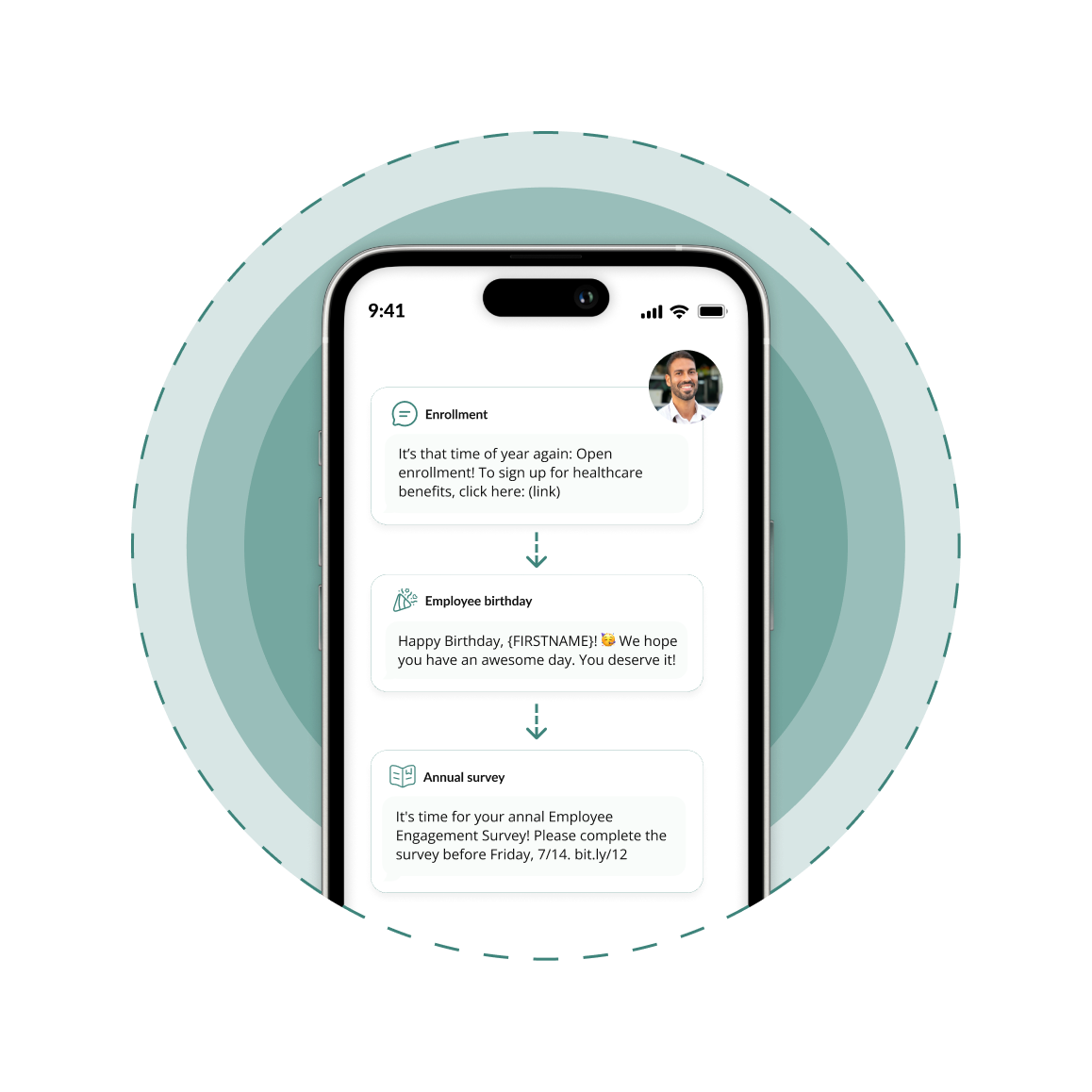
Every single worker deserves to feel seen and appreciated on their birthday and work anniversary. Beyond that, workplaces with high levels of recognition experience 31% less turnover -- so creating opportunities for ad hoc and peer recognition have a direct effect on your bottom line.
Yet most organizations struggle to deliver consistent recognition, not because they don't care, but because they're relying on systems that can't scale.
Fully automated recognition systems score highest because they guarantee consistency. Birthdays and work anniversaries are acknowledged automatically. Every worker, in every location, regardless of their manager's workload or memory, receives the same recognition. It's predictable, reliable, and fair.
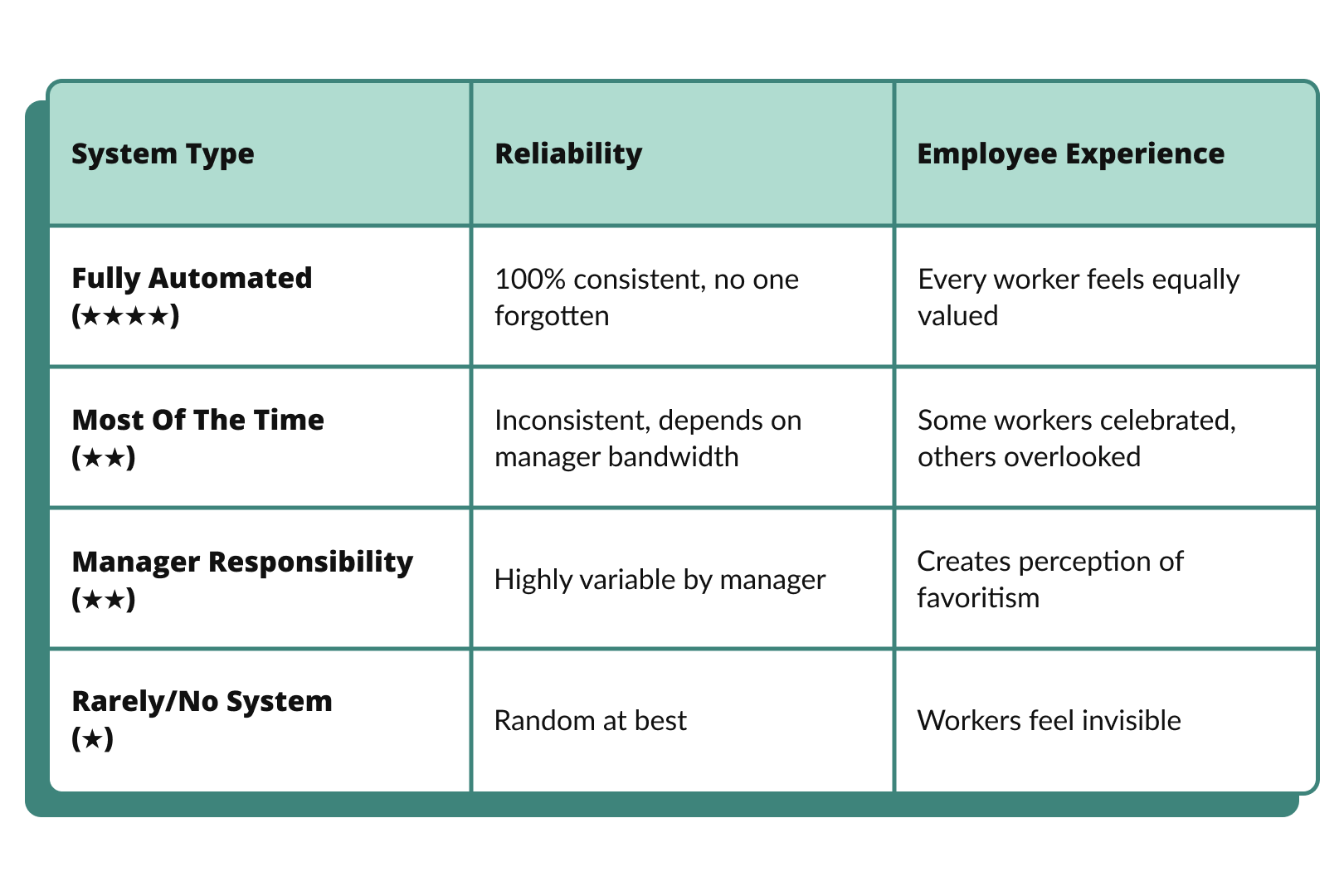
Workers don't compare their recognition to some abstract corporate standard. They compare it to what they see their peers receiving. When long-tenured workers at Location A are celebrated but similar workers at Location B are ignored, resentment builds.
Keep Contact Lists Current and Accurate
You've done everything right. You chose the right channel. You crafted a compelling message. You hit send at the optimal time. And then your message bounces to a disconnected number, or worse, reaches someone who left your company three months ago.
Organizations with automatic HRIS or payroll integration score highest because their contact lists update continuously without human intervention. When HR processes a new hire, that person's information flows automatically into the communication system. When someone's phone number changes in payroll, it updates everywhere. When an employee separates, they're removed immediately.
This isn't just about efficiency. It's about accuracy and compliance. Manually updated lists inevitably lag behind reality. New hires don't receive onboarding communications. Workers who changed their phone numbers miss important messages. Former employees continue receiving company information they shouldn't have access to.

Solicit Feedback Systematically
Your frontline workers see things leadership doesn't. They interact with customers daily. They spot operational inefficiencies. They know which policies work in theory but fail in practice. This insight is incredibly valuable -- but only if you can actually capture it.
The best organizations run regular, automated surveys that consistently achieve response rates exceeding 60%. They've made feedback incredibly easy to give. Short surveys. Mobile-optimized. Delivered via text message with one-click response options. No logging into portals. No lengthy forms. Just quick, frequent pulse checks that workers can complete in under a minute.
High response rates matter because they ensure your feedback represents your actual workforce, not just the most vocal subset. When only 30% of workers respond to surveys, you're getting feedback from a specific demographic that might not reflect the majority's experience.
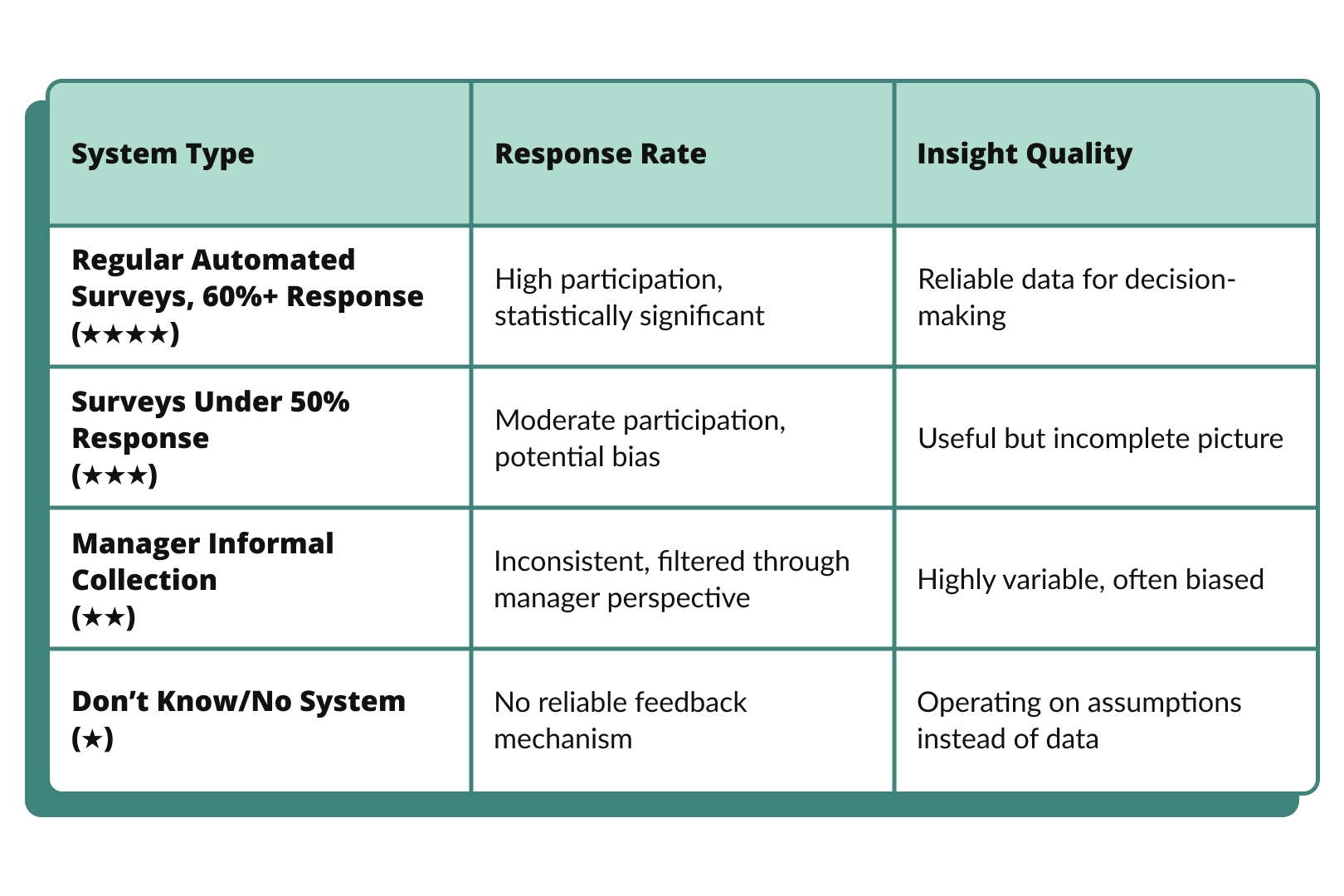
Relying on managers to informally collect feedback creates inherent bias. Managers filter feedback through their own perspectives. They might downplay criticism of their own leadership. And some managers are simply better listeners than others.
Act on the Feedback You Receive
This is where many organizations fail catastrophically. They run elaborate surveys. They collect detailed insights. They thank workers for their input. And then nothing changes.
Workers aren't oblivious. They notice. And the next time you ask for feedback, response rates plummet because they've learned their input doesn't actually matter.
Organizations that act consistently on feedback score highest -- but "acting on feedback" doesn't mean implementing every suggestion. It means closing the loop. Demonstrating genuine responsiveness even when you can't give workers exactly what they asked for.
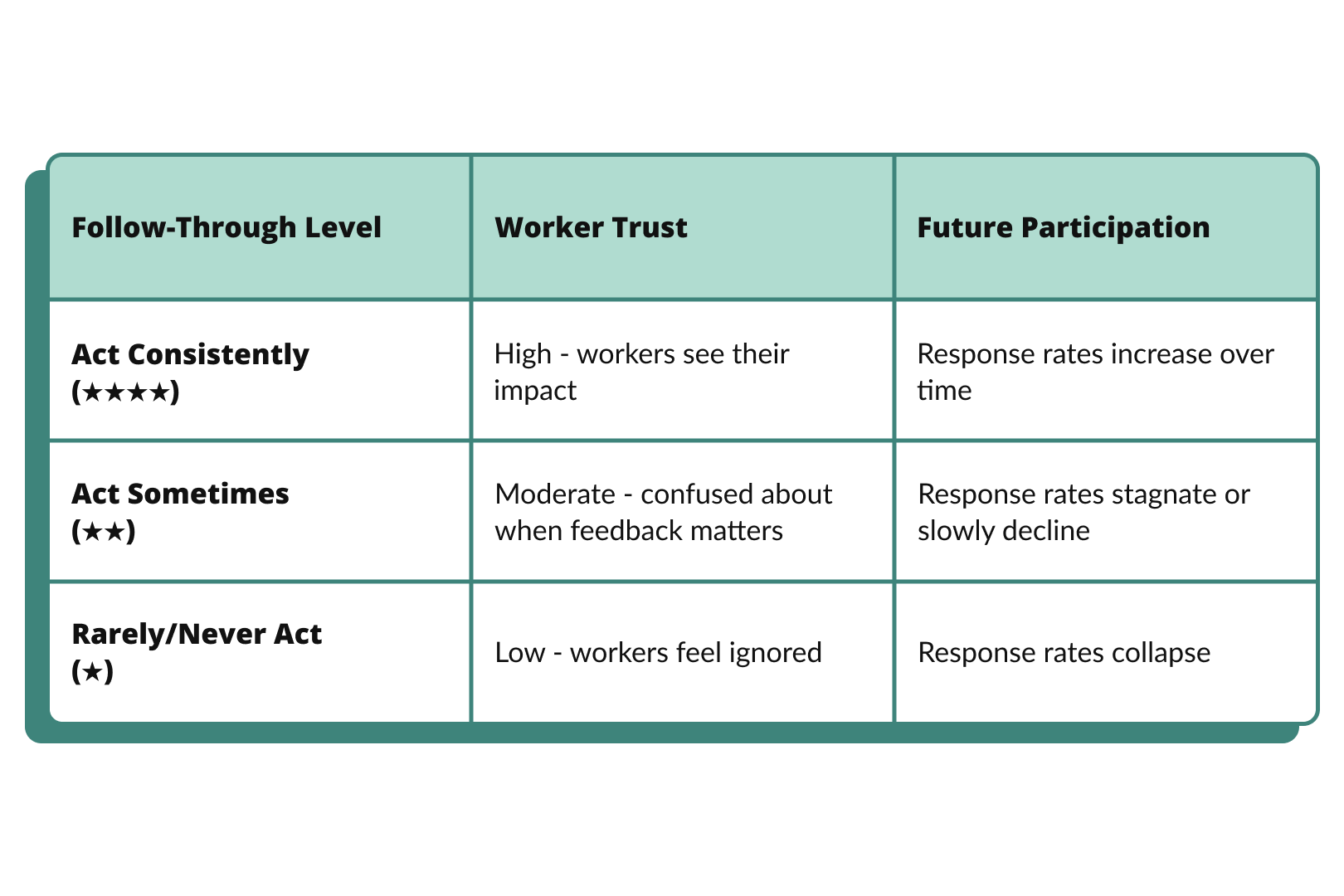
When workers see their feedback leading to real changes, they become more engaged in providing feedback. They give more thoughtful responses. They trust that leadership is listening.
The Real Problem? Most Tools Create Connection Blockers.

If you're reading this and thinking "we're failing at most of these," you're not alone. And it's probably not your fault.
Most organizations don't struggle with frontline communication because they don't care or don't try. They struggle because their current tools create connection blockers at every turn.
Apps that nobody downloads. Portals that require passwords nobody remembers. Email systems that exclude half the workforce. Manual processes that can't scale. Fragmented systems that don't talk to each other. These aren't minor inconveniences. They're fundamental barriers preventing you from reaching the people who make your business run. See what these gaps are costing you.
The organizations really getting through? They've figured out three things:
Go simpler.
Remove friction from every interaction. No apps to download, no logins to remember, no barriers between your message and your workers. Text-based communication that meets workers where they already are.
Go smarter.
Use data and automation to ensure consistent, targeted communication. Automatically sync with your HRIS so contact lists stay current. Track engagement so you know what's working. Segment intelligently so messages reach the right people at the right time.
Stay closer.
Build continuous feedback loops. Automate recognition so no one gets forgotten. Make it effortless to share input. You can't do these things with disconnected tools, processes and platforms that were designed for office workers.
The Answer? goHappy.
You could keep using the same tools that created your current score. Keep sending messages you're not sure anyone reads. Keep wondering why turnover stays high and engagement stays low. Keep treating frontline communication as an unsolvable problem.
Or you could see how organizations are actually solving this.
Companies reaching 98%+ of their frontline workers. Companies reducing turnover by 10% after three years. Companies where workers actually respond to surveys because they trust their feedback matters. Companies where emergency communications reach everyone, every time, with certainty.
They're not doing it with magic. They're doing it with tools built specifically for frontline communication challenges. They're doing it with goHappy.
.png)

.webp "download (9)")