















If you take one thing from our research this year, I would suggest that it’s this: 70% of the variance in engagement across organizations traces back to the leader.
That stat is one of the most encouraging findings in all of frontline research, because it means 70% of the outcome is something you can change.
Everything in the 2026 State of the Frontline Worker Report lines up with it. Where leader behavior is consistent, the employee experience improves. Where the experience improves, engagement follows. Put simply, engagement is less a reflection of your team and more a reflection of how their leaders show up for them.
The four leader actions that matter most
We organize leadership into four observable actions: be authentic, appreciate, connect, and coach. These aren't skills a person is necessarily born with, but they can be learned; they are things a leader either does or doesn't do and the data captures the difference plainly.
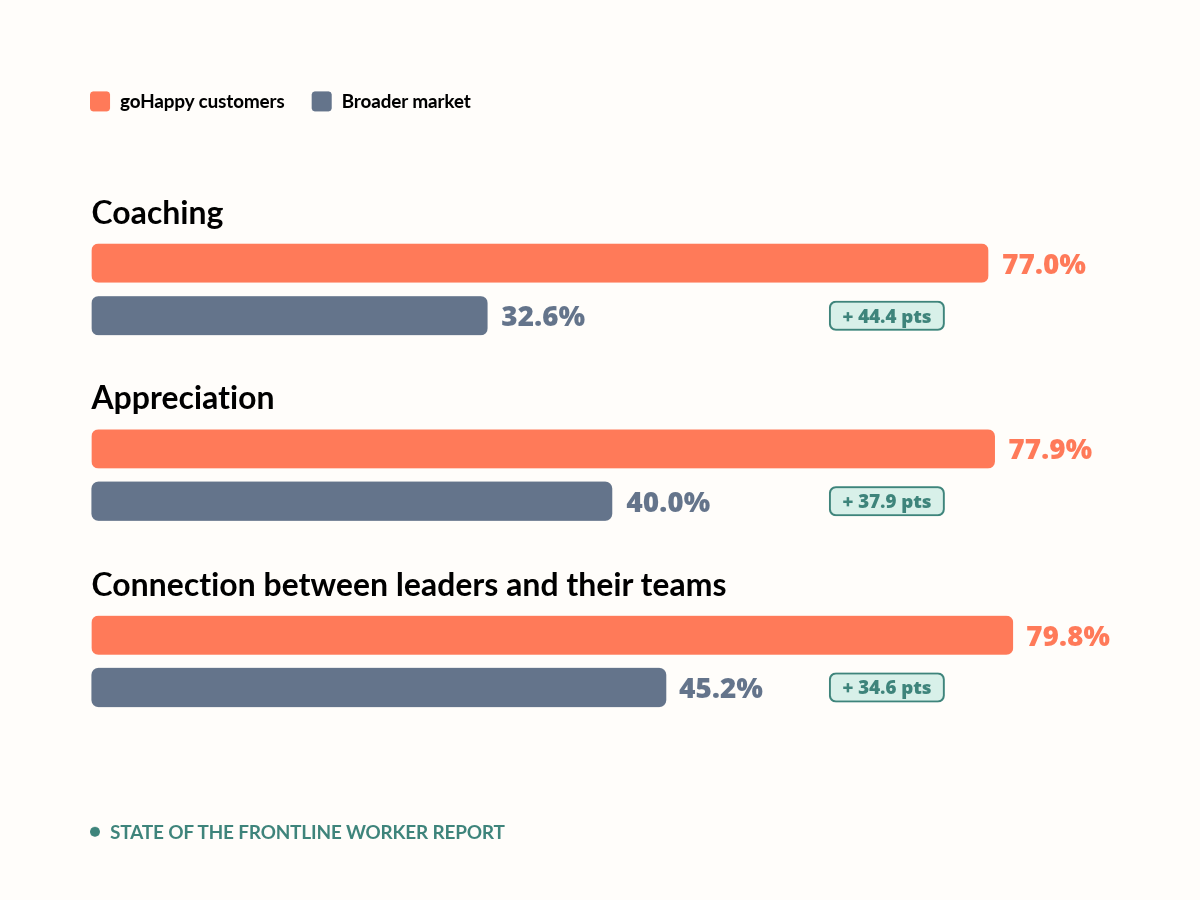
On every one of them, our customers separate sharply from the market. Coaching came in at 77.0% favorable among goHappy customers against 32.6% in the broader market. Appreciation, 77.9% against 40.0%. Connection between leaders and their teams, 79.8% against 45.2%. Those are the widest gaps in the entire study, and every one of them lives in the daily flow of work.
Authenticity led the way
The biggest year-over-year gain for goHappy customers was in the leader behavior, “Be Authentic”, which rose 13.2 points, up from 62.9% to 76.1%. In 2024 it was the lowest-scoring behavior we measured. One year later it was the strongest.
Authenticity in this context is measured by the following: is communication consistent, do words line up with actions, do people feel safe being honest about their experience. An increase of 13.2 points happens when leaders become more visible and more consistent, day after day.
Mainsail, a hospitality group, is a great example of what that looks like in practice. Rather than assume leaders already knew how to have honest conversations, Mainsail trained them on it, giving frontline leaders real scenarios and language to open up feedback and, just as important, to follow through on what they heard. The goal was simple: build trust through more frequent, honest communication between leaders and their teams.
As Jeanette de Sousa, Mainsail’s Corporate Director of HR, put it, “It’s a trust relationship. When they feel heard and know what to expect from their manager, that’s when you see someone willing to go the extra mile.” The payoff is something you can point to: Mainsail earned goHappy’s Happiest Frontline Employees certification in both 2025 and 2026.
The good news
If engagement was purely a function of hiring or market forces, there wouldn't be much a leader could do about it. Fortunately, the opposite is true. Effective leadership is the driving force behind frontline worker engagement. And, the actions driving the biggest gaps are easily within reach: being authentic, appreciating your team, connecting with your team and coaching them..
None of that necessarily requires a new program or additional budget. It simply is organizations and their frontline leaders having an intentional focus on those 4 key leader actions.
See what high-performing leaders do differently
The full report breaks down all four leader behaviors, how they moved year over year, and how they connect to retention. Get your copy of the 2026 State of the Frontline Worker Report.
See what high-performing leaders do differently >>
Leadership and Employee Engagement FAQ
How much does leadership affect employee engagement?
Gallup research shows that 70% of the variance in engagement across organizations traces back to the leader. That makes leadership the part of engagement employers can most directly change. The 2026 State of the Frontline Worker Report points the same way: where leader behavior is consistent, the employee experience improves, and engagement follows.
What are the four leader actions that drive frontline engagement?
goHappy organizes leadership into four observable actions: be authentic, appreciate, connect, and coach. These are behaviors a leader either does or doesn’t do, so they can be learned and measured instead of depending on natural talent. The widest gaps between goHappy customers and the broader market showed up on coaching, appreciation, and connection.
What does it mean for a leader to be authentic?
In the report, authenticity is measured by whether communication is consistent, whether words line up with actions, and whether people feel safe being honest about their experience. Among goHappy customers, the Be Authentic score rose 13.2 points, from 62.9% favorable in 2024 to 76.1%. It went from the lowest-scoring leader behavior to the strongest in one year, which happens when leaders become more visible and consistent day after day.
How do goHappy customers compare with the market on leader behaviors?
Customers scored higher on every leader behavior measured. Favorable results for coaching were 77.0% against 32.6% in the broader market, appreciation 77.9% against 40.0%, and connection between leaders and their teams 79.8% against 45.2%. These were the widest gaps in the entire study.
How can frontline leaders improve engagement?
Start with intentional focus on the four leader actions, which doesn’t necessarily require a new program or additional budget. Mainsail, a hospitality group, trained its frontline leaders with real scenarios and language to open honest feedback conversations and follow through on what they heard. The company earned goHappy’s Happiest Frontline Employees certification in both 2025 and 2026.